


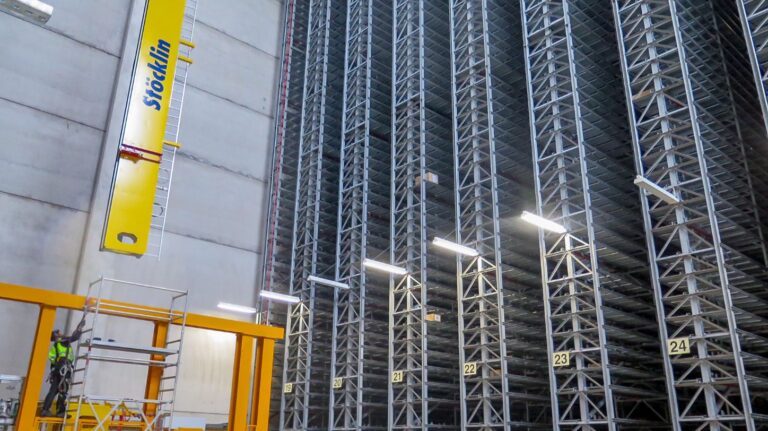
The first of 61 new stacker cranes has been installed in the high-bay warehouse at Hermes Fulfilment’s centre in Haldensleben, Germany.
The site, which serves as a key logistics hub for the Otto Group’s retail companies, specialises in handling small-volume items, including clothing and footwear. Opened in 1994, the warehouse ships to more than 20 European countries and handles returns.
Phased replacement of the stacker cranes is underway at the Haldensleben high-bay warehouse, scheduled for completion by the end of 2028.
“The risk of failure is increasing. Electronic spare parts won’t be available for much longer. To ensure we can continue using the high-bay warehouse in the future, we’ve decided to completely replace the stacker cranes in nine construction phases,” said Barbara Schröder form logistics planning at Hermes Fulfilment.
The first stacker crane, supplied by Stöcklin, was installed utilising a 60-metre heavy-duty crane. It was lifted into the high-bay warehouse in two parts through 10m2 roof opening.
In total a further sixty 27-metre-tall cranes will be installed, enabling each of the 61 warehouse aisles to be severed by its own dedicated crane. To date, 39 stacker cranes have been used, switching aisles with the help of eight transfer shuttles.
The new cranes, which weigh four tonnes less than their predecessors, can travel along the racking aisles at speeds of up to four metres per second. Although each crane can only carry three cartons at a time rather than 15, the increased number of units and other features are expected to boost the warehouse’s from 3,500 to as many as 3,900 storage and retrieval operations per hour.
“By replacing the stacker cranes, we’re continuing to invest in the future of this site and sending a clear signal – Haldensleben will remain a flagship logistics location within the Otto Group,” said Stefan Nießen, head of the distribution centre.
The replacement of the stacker cranes follows upgrade of the material flow computer earlier this year.
Four more cranes are planned for installation in the second quarter of 2026. Once removed the old cranes, excluding any components fit for reuse, will be scrapped.