


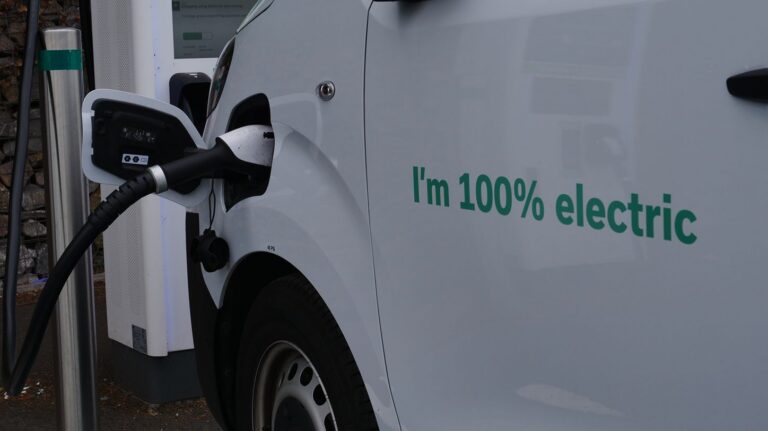
The UK’s public electric vehicle (EV) charging network has continued to expand, but electric van uptake remains well below government-mandated levels, according to figures from the UK Department for Transport (DfT) and the Society of Motor Manufacturers and Traders (SMMT).
The latest DfT monthly faster indicators show that, as of 1 July 2026, there were 121,171 public EV chargers in the UK, including 28,887 rapid or ultra-rapid chargers rated 50kW and above. The figures were published as part of DfT’s monthly public EV charger dataset, which is sourced from Zapmap.
The latest quarterly official statistics, covering the period to 1 April 2026, reported 119,080 public EV chargers in the UK, including 27,372 rated rapid or above. The DfT said 3,028 EV chargers were added to the public network in the first quarter of 2026, following 13,281 added during 2025.
However, the SMMT said the growth in charging infrastructure has not yet translated into sufficient electric van demand.
According to the SMMT’s latest light commercial vehicle registration figures, the UK van, pickup and 4×4 market rose 12.2% year-on-year in June to 31,602 units, while first-half registrations increased 1.7% to 158,648 units.
Battery-electric van registrations rose for a third consecutive month, increasing 23.2% in June and taking an 11.5% market share. Across the first half of 2026, electric van market share increased from 8.6% to 9.9%.
The SMMT warned that demand remains well below the 24% share mandated this year under the UK’s zero-emission vehicle framework. It said meeting the target outright would require electric van uptake to average around 40% market share over the next six months, describing such growth under current conditions as “implausible”.
Mike Hawes, chief executive of the SMMT, said: “The market’s return to growth is encouraging, but it comes against a backdrop of lower volumes and significant market disruption over the past 18 months, not least the sharp fall in pickup demand after tax changes.
“While businesses continue to invest in new vans, zero emission uptake remains well below ambition, holding back the fleet renewal needed to deliver net zero.
“A successful transition requires regulation, infrastructure and incentives to work together, giving operators the confidence to invest.
“With the gap between targets and demand continuing to widen, urgent reform of the mandate is needed to keep the transition on track.”
The SMMT said barriers to electric van uptake include higher upfront costs, charging infrastructure concerns and operating cost pressures, despite most van models now being available with a plug.
The DfT’s latest charging grant statistics show that workplace charging grant schemes have funded 81,448 installations since 2016, including 11,865 in the last 12 months. The Workplace Charging Scheme has funded 69,439 socket installations, while the EV infrastructure grant for staff and fleet has funded 6,199 socket installations and £8.3m of support.
However, the staff and fleet infrastructure grant closed to customer applications on 31 March 2026, alongside the infrastructure grant for residential landlords and the chargepoint grant for commercial landlords.
In its Blueprint for 2030 report, the SMMT said the zero-emission transition should be reviewed and regulations updated to reflect market reality and global conditions. The report calls for greater deployment of infrastructure and other “key enablers” to support zero-emission mobility.
The report also said specific infrastructure is required for heavy-duty and commercial vehicle use, with additional focus needed on depot charging and hydrogen technologies to support fleet operators.
The SMMT warned that the zero-emission HGV transition has “barely begun”, with zero-emission vehicles accounting for just 1.5% of new HGV registrations in the UK. It said the economic business case for fleet operators does not yet exist and called for a joined-up approach to regulation, charging infrastructure and incentives.
The UK’s public EV charging network is continuing to grow, but electric van uptake remains well below government-mandated levels.
For logistics operators, retailers, service fleets and urban delivery businesses, the challenge is whether the UK can deliver the depot, en-route, grid and heavy-duty charging infrastructure needed to make electric vans and zero-emission HGVs operationally viable at scale.
This is one of the core issues Urban Logistics will examine. Taking place at Excel London on 9-10 June 2027, the event’s Urban Fleet & Infrastructure Theatre will explore electric van uptake, commercial vehicle charging, depot infrastructure, zero-emission HGVs, regulation, incentives and the practical realities of fleet transition.
Contact urbanlogistics@akabomedia.co.uk for more information.