


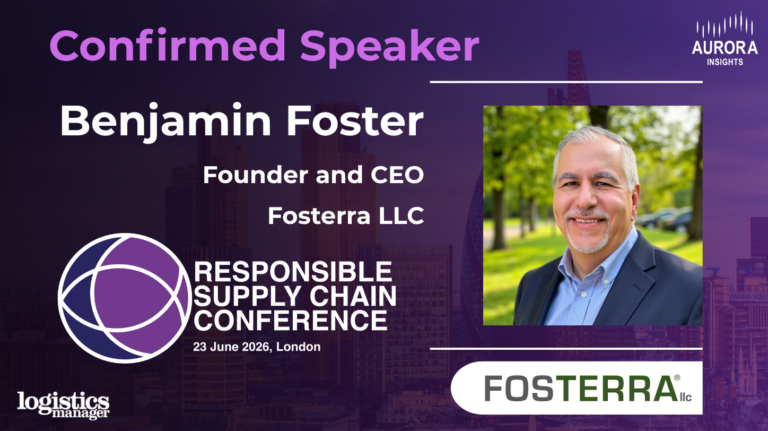
As the Responsible Supply Chain Conference (RSCC) London approaches, Logistics Manager profiles the experts set to speak at the renowned event.
Organised by Aurora Insights with Logistics Manager, the event will take place at the prestigious 30 Euston Square, London – a Grade II listed events venue in the heart of central London.
From raw material extraction to last-mile delivery, supply chains are being tested by disruption, higher disclosure expectations and growing scrutiny of labour, sourcing and environmental impact.
Organisations that can evidence progress, manage risk in their supplier base and convert sustainability goals into operational execution will be better placed to protect reputation, maintain access to markets and build resilience.
Packed into a singular in-depth day, RSCC focuses on platforming industry experts that tackle these challenges face on, determining whether responsibility is real in practice and how sustainability affects everything from product and packaging design choices, supplier due diligence and assurance, credible emissions reporting and reduction, operational decarbonisation and the operating model required to embed progress.
One of the experts confirmed to speak at the event is Benjamin Foster, Fosterra LLC founder and CEO.
Foster founded Fosterra LLC to deliver sustainability, green energy, and clean transportation results for the commercial, government, education, and utility sectors.
Foster has worked on projects in over 500 jurisdictions across the United States and globally at various stages of development from planning through operations.
As an industry leader, Foster has also led more than a dozen regional collaborative efforts to improve best practices and deploy them across the United States and internationally through federally funded projects, industry whitepapers, technical reports, best practice guides, and market-oriented training.
He is a highly regarded speaker on three continents at clean technology events and leading institutions on the topics of government energy strategy, solar economics, cleantech innovation, product lifecycle management, and global supply chain sustainability.
Name: Benjamin Foster
Job Role: Founder and CEO
Organisation: Fosterra LLC
What do you see as the biggest challenge organisations face when trying to move from sustainability commitments to real implementation across global supply chains?
The core challenge is translating high-level targets into operational requirements that suppliers can actually execute against. In our experience, companies stall when sustainability is treated as a reporting exercise rather than embedded into procurement, product design, and supplier performance metrics. The most effective approach is to align incentives tied to sourcing decisions and supplier scorecards combined with meaningful support and engagement to take action on common targets.
How can companies improve the quality and reliability of Scope 3 emissions data while working with large and complex supplier networks?
Most Scope 3 data issues stem from over-reliance on estimates instead of building supplier site-level data capability. Companies need to prioritize a phased approach: start with high-impact categories, standardise data requests, and invest in supplier training and simple digital tools to improve primary data collection. Systems must be “supplier centric” because if data collection is simple and requires low effort, then the responses will be faster and more accurate.
What practical steps can organisations take to strengthen supplier governance and ensure meaningful human rights due diligence throughout their supply chains?
Audit-based compliance alone is insufficient because it often misses systemic risks. Leading organisations are shifting toward continuous engagement by combining risk-based segmentation, worker voice mechanisms, and direct supplier capability building. Embedding these expectations into contracts and supporting long-term partnerships ensures accountability while driving real improvements on the ground.
How is the concept of the circular economy evolving within supply chain management, and where are companies making the most tangible progress?
The circular economy is moving from concept to execution through material-level interventions rather than broad commitments. We’re seeing the most progress where companies focus on manufacturing waste and redesign products for recyclability, invest in alternative materials, and collaborate with suppliers to close specific loops (e.g., packaging, metals, textiles). Extended Producer Responsibility (EPR) regulations are also building networks that can create value streams from end-of-life product handling.
What role do digital technologies and data platforms play in improving traceability, transparency, and accountability across modern supply chains?
Digital platforms are becoming the backbone for scaling supply chain sustainability by enabling consistent data collection, traceability, and performance tracking. However, technology only delivers value when paired with clear standards, supplier engagement, and integration into business workflows. The real impact comes when data moves beyond visibility to drive procurement decisions, risk management, and continuous improvement across the network.
Responsible Supply Chain Conference London takes place 23 June 2026 at 30 Euston Square, London. For speaker information and attendee registration, visit the official event website at www.supplychainconference.co.uk