
The automotive supply chain is being redrawn. China is growing as a source of finished vehicles and components, North Africa is becoming increasingly important to European manufacturing and geopolitical disruption is forcing businesses to reconsider established routes.
For logistics operators, the opportunity is not simply to provide more capacity. It is to give customers more options.
“The client does not choose a specific mode of transport, they choose a logistics chain that works,” says Juan Riva, CEO of SUARDIAZ Group.
That principle is becoming increasingly important as automotive trade flows change. China is growing not only as a source of finished vehicles, but also of components, while new vehicle flows are putting additional pressure on car-carrier capacity. For logistics providers, the opportunity goes beyond maritime transport, with customers increasingly requiring connected solutions across shipping, storage, inland transport and infrastructure.
Rather than viewing maritime, road and rail as competing choices, SUARDIAZ sees them as parts of the same logistics chain, with the right combination determined by cost, frequency, reliability and transit time.
Resilience through choice
Geopolitical disruption has added urgency to that approach. When established routes are disrupted, voyages become longer, fuel consumption increases and effective transport capacity falls.
More significantly, it is changing what customers value.
“Customers increasingly value resilience, alternatives and less dependence on a single corridor,” says Riva.
This is strengthening the case for short sea shipping and multimodal transport. SUARDIAZ has worked with this model for decades through Motorways of the Sea and door-to-door solutions, while the development of industrial centres closer to Europe is creating further opportunities.
North Africa is particularly significant. Morocco’s growing role as an industrial hub reflects a wider regionalisation of supply chains that was already under way, but which could be accelerated by geopolitical uncertainty as businesses place greater weight on cost, security of supply and the ability to respond quickly.
Investing in capacity and flexibility
SUARDIAZ is backing this outlook with investment. Over the past six years, the Group has invested more than €350 million (approximately £294m) across its business, including fleet renewal, logistics infrastructure, international expansion and multimodal capabilities.
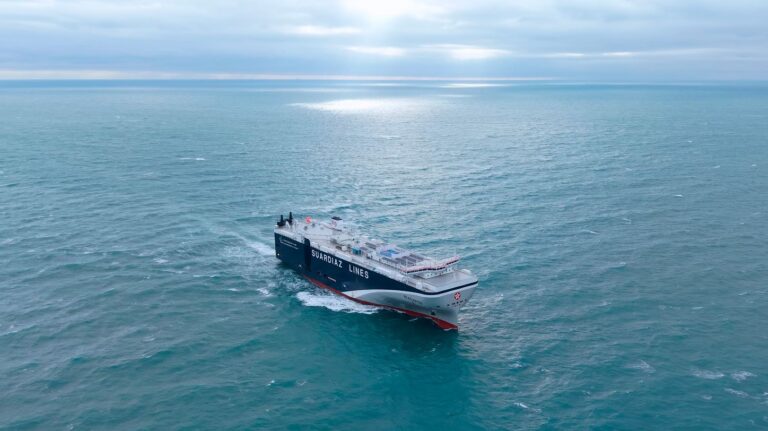
Its new RS Atlantico provides a tangible example. The 5,500-CEU vessel is the largest yet to join SUARDIAZ’s RoRo Car Carrier division and will reinforce the Atlantic corridor between North Africa and Europe.
That additional capacity comes as the geography of automotive production itself is changing.
“Automotive is part of our history and will remain a strategic sector,” says Riva. “What is changing are the centres of production, trade flows and technologies.”
SUARDIAZ sees growing importance for both North Africa and Asia and intends to continue developing its automotive business as those flows evolve.
No single route to decarbonisation
The same emphasis on flexibility shapes SUARDIAZ’s approach to the energy transition.
RS Atlantico uses dual-fuel LNG technology, with SUARDIAZ viewing LNG as a transitional technology rather than the industry’s final destination.
“Today, there is no single technology capable of solving the decarbonisation of maritime transport; it is necessary to combine fleet renewal, efficiency, route optimisation and new fuels,” says Riva.
SUARDIAZ has already used biofuels and implemented measures to improve fleet efficiency. Future investment decisions will take into account technological maturity, availability, infrastructure, cost and regulation, as well as the emissions reductions different solutions can deliver.
It is an approach that reflects the wider challenge facing automotive logistics. Whether responding to new production centres, geopolitical disruption or the transition to lower-emission transport, the ability to adapt is becoming as important as the ability to deliver.
For automotive manufacturers, resilience increasingly means having options before they are needed. As production centres shift, trade corridors evolve and technology changes, the strongest logistics chains will be those with flexibility built in from the start. For SUARDIAZ, continued investment in new capacity, multimodal connections and its international network is designed to provide exactly that.