


Warehouse and production operations generate a large amount of information every day. Order statuses, stock levels, process messages, technical tickets and work instructions are all available somewhere in the organisation. Yet when an employee needs an answer during a running process, this information is often spread across several applications, documents, and system views.
A delayed order may require a check in the warehouse management system. A disruption at an automated workstation may involve a ticketing tool, a system message and technical instruction. A question about a particular item may require knowledge of stock, locations, and current allocation of status. In many cases, the information exists, but accessing it takes the employee away from the task.
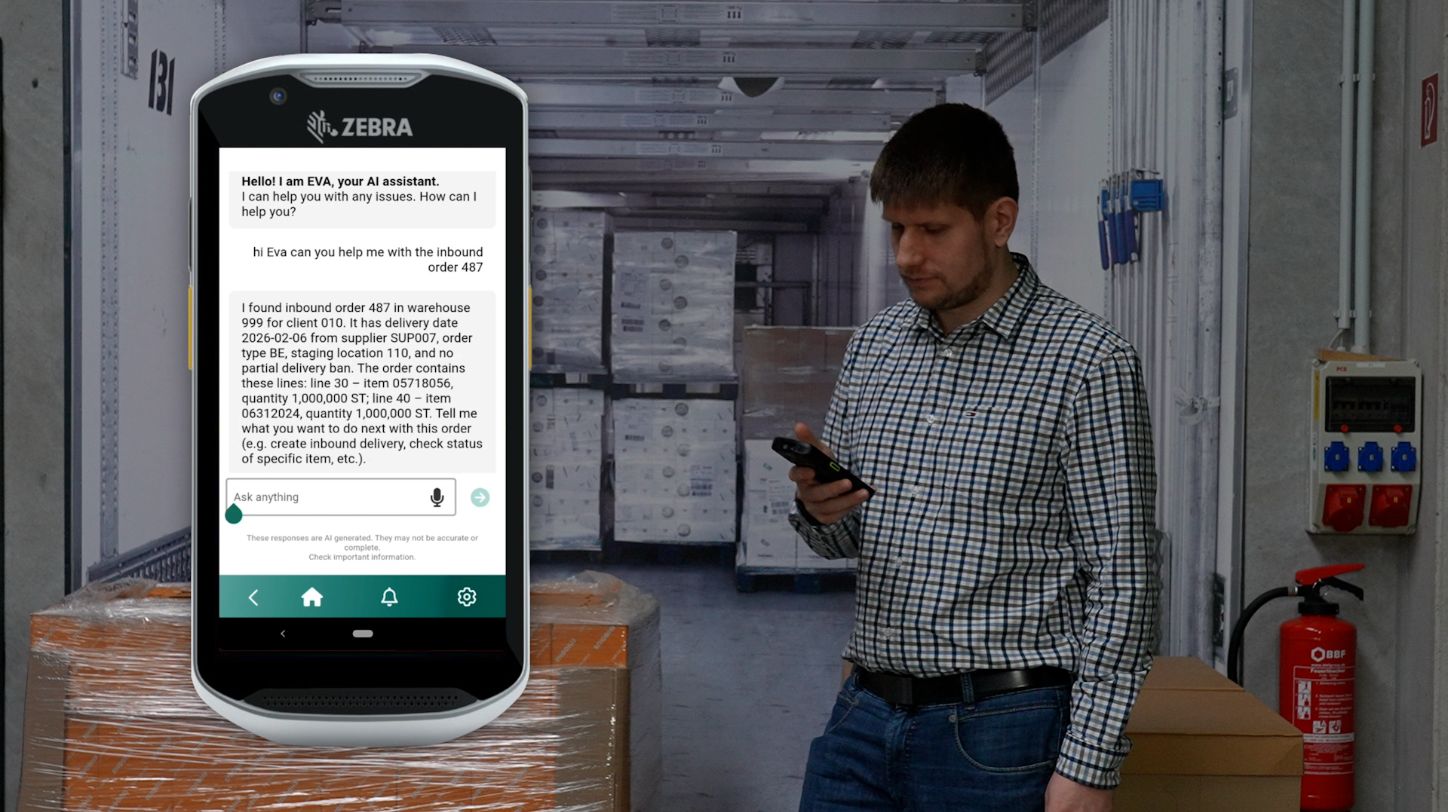
The EPG AURA Communicator addresses this gap. It provides a dialogue-based access point for operational data and enterprise knowledge, allowing employees to ask questions in natural language instead of searching through individual systems. The Communicator can make information from approved sources available in the context of the current task, whether the question concerns an order, a stock position, a process status or an existing instruction.
Information access during the working day
Operational systems are built to execute and control specific processes. Warehouse management systems manage stock and orders. Automation systems coordinate material flow. Ticketing tools document disruptions and support activities. Each application fulfils a clear purpose, yet employees often need information that sits across these boundaries.
This is particularly evident when a process does not continue as expected. A worker may see that an order is waiting, but not know whether the cause is missing stock, a blocked process step or a technical issue. Finding the answer can mean opening several interfaces, searching through documentation or contacting a supervisor. The result is a short interruption that may delay the next task and create further questions for the shift team. With the AURA Communicator, users can formulate their question directly. They do not need to know in which system an answer is stored, which report contains the relevant status or how a ticket has been categorised. The Communicator evaluates the connected sources and provides the information relevant to the request.
This can include operational data such as order status, priorities, stock availability, storage locations or current process conditions. It can also include work instructions, documentation, system messages and information from connected ticketing or knowledge-management applications. Companies decide which sources are available and which information different user groups may access.
A conversational layer for existing systems
The Communicator does not replace the systems that run warehouse, automation or transport processes. They remain responsible for their respective operational tasks. The Communicator makes the information held within and around these systems easier to access. This is useful because system landscapes have grown over time. Most companies have established applications that support individual areas of their operation effectively. The challenge is often less about adding further data than about making existing data and knowledge usable across the working day.
A dialogue-based interface reduces the need for users to understand every system structure before they can retrieve information. Instead of navigating menus and masks, they can ask a question in the way they would ask an experienced colleague. The answer remains based on the sources that the company has made available for that purpose. For shift managers, this can reduce recurring requests about process conditions or open tasks. For service teams, it can simplify access to documentation and ticket information. For warehouse employees, it can make task-related information available without a lengthy search through different applications.
Hands-free access with LYDIA Voice
The AURA Communicator can be accessed through EVA, the EPG Virtual Assistant, as a chat application. This suits users who work at a desk, in a control room or at a stationary terminal. They can ask for information in natural language and receive answers without changing between multiple applications.
In warehouse environments, however, information access cannot always depend on a screen and keyboard. Employees may be moving through an aisle, handling goods, working at a packing station or operating close to automation. Stopping work to use a terminal is not always practical, particularly when the answer is needed for the next operational step. LYDIA Voice gives the Communicator a hands-free access channel for these situations. Employees can ask a question verbally while remaining within their working environment. They can request information about an order, a stock position, a process status or a relevant instruction without having to interrupt the task to search through a system interface.

The conversational access is particularly relevant because LYDIA Voice is already designed for operational work. Employees use voice-guided processes to receive and confirm instructions while keeping their hands and attention focused on the task. The Communicator adds a further capability: access to information when the process raises a question that cannot be answered by the current instruction alone.
An employee can therefore continue to work in the familiar LYDIA Voice environment while also retrieving information that may be held in the wider system landscape. The Communicator remains the source of the dialogue-based information access; LYDIA Voice makes that access usable where hands-free interaction is required.
Supporting independent decisions in operations
Many recurring questions in warehouse operations are currently resolved through personal knowledge. Employees ask colleagues, supervisors or technical specialists because they do not have direct access to the relevant information. This creates dependencies that become more visible during busy periods, shift changes or when experienced staff are unavailable.
The Communicator can support a more independent way of working by making approved information accessible to the people who need it. A warehouse employee can clarify why an order is not progressing. A shift manager can check the status of open process issues. A service employee can see whether a ticket has already been created and whether supporting documentation is available.
Access remains role based. Employees receive information appropriate to their responsibilities, and companies retain control over the systems and knowledge sources that are connected. This is essential where operational data, technical documentation and internal processes are involved. The approach can also help international teams work with complex systems more easily. LYDIA Voice supports more than 60 languages, allowing the hands-free interaction to be used in the language appropriate to the employee and the operation.
Better use of operational knowledge
The AURA Communicator turns existing operational data and enterprise knowledge into something that can be addressed directly. It shortens the path between a question on the warehouse floor and the information needed to continue the process.
For organisations, this can reduce time spent searching, switching applications and resolving routine questions through individual experts.
For employees, it means that relevant information is available closer to the moment of work.
The practical value lies in making connected systems more accessible without changing their role in process execution. Information no longer has to be sought out through separate interfaces whenever a question arises. With the AURA Communicator, it can be requested directly through chat where a screen is available and through LYDIA Voice where hands-free access keeps the operation moving.