


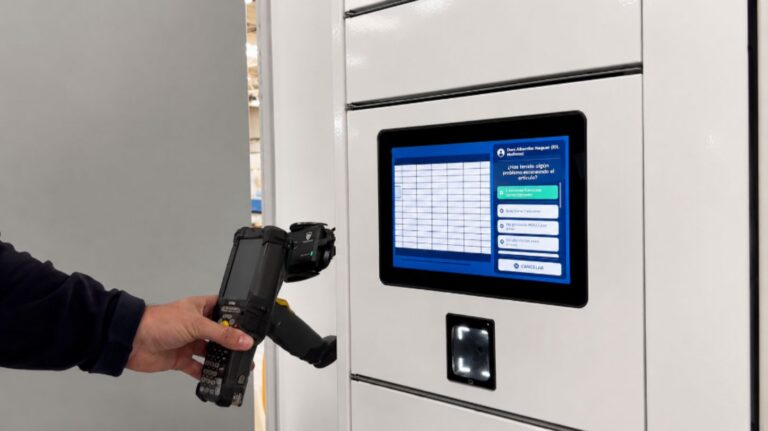
Why Smart Lockers are becoming part of the operational infrastructure for scanners, handheld terminals and shared devices
Warehouse productivity is often measured in throughput, pick rates and labour efficiency. Yet one source of lost productivity remains easy to overlook: the time operators spend getting access to the devices they need to work.
Handheld scanners, RF terminals, PDAs, mobile computers and tablets are now embedded in everyday warehouse processes, from receiving and put-away to picking, replenishment and inventory control. When those devices are missing, uncharged or unavailable, the consequences are operational rather than purely technological.
A shift can start with operators waiting for equipment. Supervisors may have to distribute devices manually. A missing scanner may trigger a search across the warehouse. A device returned with a depleted battery can become unusable for the next operator. If equipment is damaged, the problem may only become apparent when another worker attempts to use it.
Individually, these interruptions may take only a few minutes. Across a large distribution centre, multiple shifts and hundreds of operators, they can become a recurring productivity cost.
From device storage to operational control
This is where Smart Lockers are moving beyond their traditional role as secure storage.
A warehouse Smart Locker can provide a controlled point for the issue, return, charging and tracking of shared operational devices. An asset control solution for warehouses and industrial operations allows employees to authenticate using credentials such as RFID, QR codes or PINs, collect the required equipment and return it to the same controlled environment after use.
Each transaction can be digitally recorded, linking the device to the user and the time of collection and return. This creates an auditable chain of custody without requiring a supervisor or manual sign-out sheet to manage every handover.
For warehouse managers, the benefit is greater visibility of device availability and utilisation. For IT and maintenance teams, it provides information about where equipment is, who has used it and whether it has been reported as damaged. For warehouse operatives, the benefit is simpler: the device is available when the shift begins.
This approach is particularly relevant to scanner and handheld-device management in warehouse and logistics environments, where automated check-in, check-out and charging can help keep equipment ready for the next shift.
Availability means more than having a device on the shelf
A handheld scanner that is physically present but has insufficient battery is not operationally available.
Integrated charging changes the role of the locker. When a device is returned, it can begin charging immediately, allowing equipment to be rotated between shifts rather than relying on employees to find a charged spare.
The same workflow can also introduce a condition check. If an operator reports a damaged scanner during return, the device can be flagged and removed from normal circulation. The issue is then visible to the appropriate team before the next shift depends on the equipment.
This creates a closed operational loop:
issue → use → return → charge → check → reissue.
The significance is not the locker itself, but the removal of manual intervention from a repetitive warehouse process.
Connecting physical assets to warehouse systems
As distribution centres become increasingly automated, the infrastructure surrounding mobile devices also needs to connect with the wider operation.
Smart Locker platforms can integrate through APIs with systems such as warehouse management systems (WMS), ERP platforms and other operational software. This can allow device allocation and availability to become part of the digital warehouse architecture rather than a separate administrative process.
For organisations operating multiple distribution centres, this becomes particularly relevant. A central team can gain visibility of assets across locations without relying on individual sites to maintain separate spreadsheets or manual records.
The physical infrastructure also needs to adapt as operations change. Seasonal peaks, workforce growth, new warehouse zones and changes in device fleets can all alter the number and type of assets required.
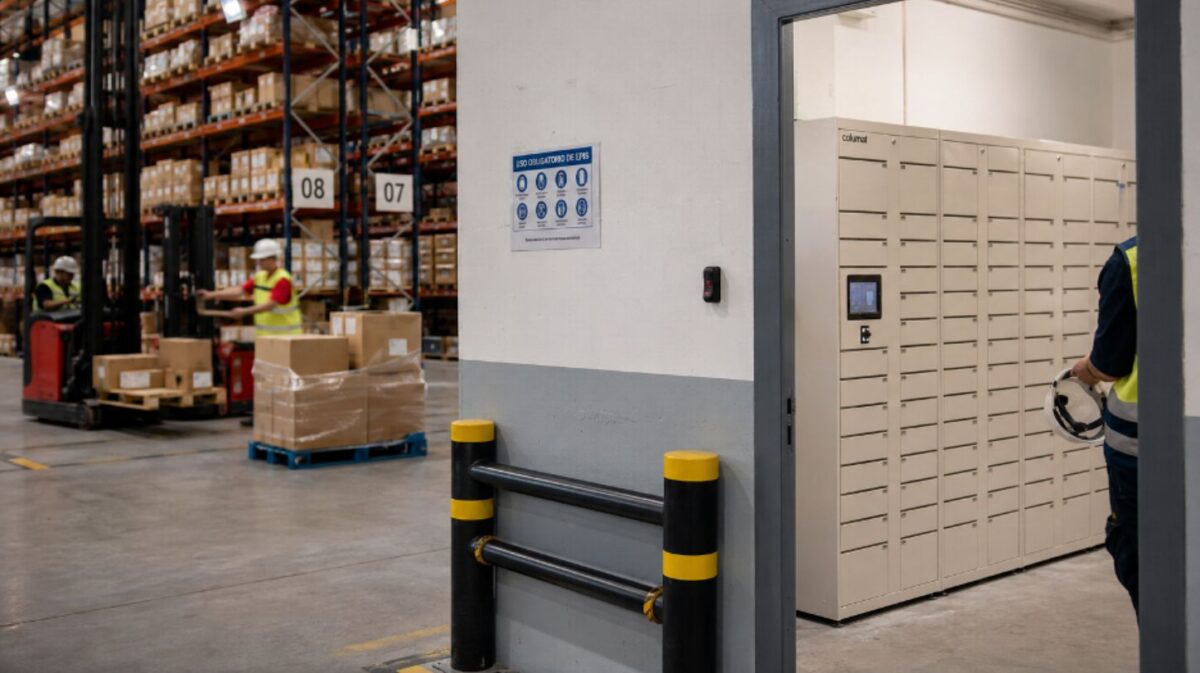
Modular Smart Locker hardware can accommodate different compartment sizes, access methods and charging configurations within the same installation. This makes it suitable for environments where scanners, handheld terminals, tablets and other shared equipment need to be managed together.
This is particularly relevant in demanding industrial and logistics environments, where equipment may be subject to intensive daily use and where continuity of operations is critical.
The economics of the missing minutes
The business case for automated device management is ultimately linked to labour productivity, equipment utilisation and asset availability.
Deployment data from Smart Locker solutions has demonstrated reductions of more than 68% in the time required for employees to self-serve equipment in some environments, while significant reductions in device losses and damage have also been reported. Such figures should not be treated as universal benchmarks: the outcome depends on workforce size, shift patterns, device volumes and the existing handover process.
The underlying calculation, however, is straightforward.
If hundreds of warehouse operatives spend several minutes each shift collecting, locating, returning or replacing shared equipment, those minutes accumulate. Add supervisors managing handovers, IT teams investigating missing devices and maintenance teams dealing with avoidable failures, and a seemingly minor process can become a measurable operational cost.
The opportunity is therefore not simply to secure scanners.
It is to make device availability part of warehouse productivity.
As fulfilment centres become more dependent on connected handheld technology, Smart Lockers can provide the physical infrastructure needed to ensure that shared devices are controlled, charged, traceable and ready for the next shift.
For warehouse and logistics operators, the question is no longer simply where devices are stored. It is whether the process surrounding those devices is helping the operation move faster — or quietly taking productivity away from it.
For more information on how Smart Locker infrastructure can support warehouse and industrial operations, Columat provides modular hardware, software and operational solutions for connected asset management.