

The growth of logistics is through connections, not just infrastructure, explains Lee Graham, director, at Quadient Lockers Europe
The logistics industry has never been short of growth opportunities. The challenge has often been how to capture that growth in a way that is both commercially sustainable and operationally efficient.
Historically, the answer was physical expansion. More facilities, more locations and more assets enabled organisations to increase reach, build capacity and support new services. But for many businesses, that equation is beginning to change.
Businesses today are placing greater scrutiny on investment decisions and looking for ways to generate value faster. As a result, many organisations are looking beyond traditional expansion and exploring how they can get more from the assets, networks and partnerships already available to them.
This shift can be seen across multiple industries. Retailers are looking for ways to make products and services more accessible without significantly expanding their physical footprint. Field-service organisations are exploring how to improve round-the-clock access to parts and equipment for engineers in the field. Logistics providers are looking for more ways to extend reach, increase utilisation and support new customer requirements without continually adding capacity through infrastructure investment.
Although the individual challenges vary, the underlying objective is often the same: finding practical ways to expand access and improve convenience without proportionally increasing costs.
Consumer expectations are also influencing how businesses think about infrastructure and accessibility. Research commissioned by Quadient found that 59% of UK consumers would prefer to manage services for multiple carriers in a single location. The same research found that almost 60% would use locker networks for services beyond parcel collection and returns.
59% of UK consumers would prefer to manage services for multiple carriers in a single location
These findings suggest consumers are becoming increasingly comfortable with shared access points as part of their everyday lives. As behaviour evolves, so too does the opportunity for businesses to use existing infrastructure in different ways.
A location that supports collections and returns today could also support spare parts distribution, click-and-collect services, key exchange, supply chain replenishment or a range of other operational and customer-facing services. The opportunity is not simply to move goods more efficiently, but to create greater value from infrastructure that is already in place.
This is where partnerships can play an important role. Shared infrastructure allows organisations to benefit from established networks rather than developing everything independently. In many cases, this can reduce the time, investment and complexity associated with expansion while improving accessibility for customers, employees and partners.
The benefit extends beyond individual organisations. When networks support multiple users and multiple services, infrastructure can be utilised more effectively and investment can generate value across a broader ecosystem. Retailers, logistics providers, service organisations and consumers all stand to benefit when assets are shared and used more efficiently.
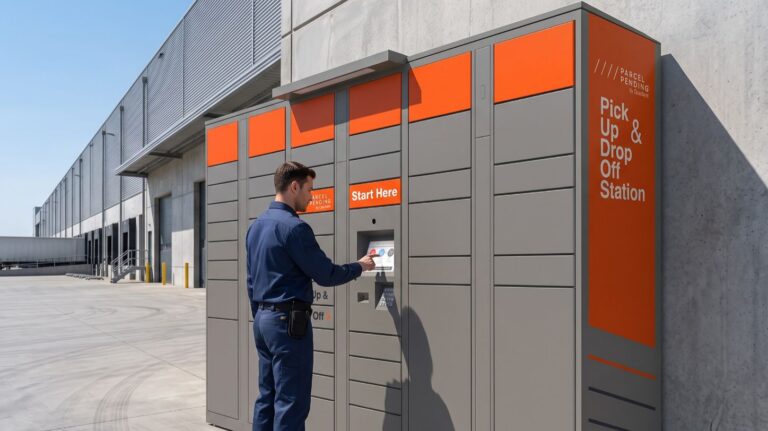
Parcel Pending by Quadient is seeing growing interest in this approach from a wide range of organisations. Through more than 3,000 open network locations across the UK, businesses have access to an established nationwide network that can support a variety of use cases. What is notable is not simply the scale of the network, but the breadth of organisations exploring how shared infrastructure can help them meet operational goals, improve customer access and support future growth.
For a long time, growth and expansion were almost viewed as the same thing. The assumption was that increasing reach required additional infrastructure, however, organisations are finding opportunities through stronger partnerships, better utilisation of existing assets and more complex and connected networks.
As businesses continue to balance customer expectations, operational efficiency and investment priorities, making better use of existing infrastructure is becoming an increasingly important part of the conversation. In many cases, the opportunity is not to build another network, but to find smarter ways to access and benefit from networks that already exist.
That is why growth in logistics is becoming less about ownership and more about connection, linking customers through smarter, more responsive networks.